
Chippewa County Warrant Checks
The Chippewa County Sheriff's Office posts an active warrant table for the whole county, and that sheet is the quickest first stop for a name. It is not a search form. It is a plain set of rows. Grab the warrant number off the row, then call 320-269-2121 and ask how the office confirms a current status. Keep the legal name and any citation or case number handy before you dial.
- Open the sheriff's Active Warrant Listing and scan it. There is no search box, so use the browser's find command.
- Call the sheriff at 320-269-2121 and ask how the office confirms a warrant and which court holds it.
- Call Chippewa County District Court Administration at 320-269-7774 about the case file, a new date, or a recall.
- Search Minnesota Court Records Online with a case or citation number. A name alone may not return a pending criminal file.
- If a warrant is active, talk to a lawyer before you do anything in person.
Checking Chippewa County's Static Warrant Table
The official list lives at a police-data host that the Chippewa County sheriff page links to straight from its site. Nothing about the table is interactive. It gets generated on a fixed schedule, so it will not filter, sort, or paginate around your query. A dynamic Last Run Date stamp at the top is the only real hint at how fresh the sheet is. Seven columns run across it: warrant number, name, date of birth, date of warrant, bond or bail amount, offense level, and a short description. Levels read Felony, Gross Misdemeanor, or Misdemeanor. The description is free text, and locally it carries reasons like failure to appear, DWI, and order-violation language. What is missing matters too. There is no judge, no court, no bond type, and no status-change date anywhere on a row. Before you rely on the sheet, open the sheriff's Active Warrant Listing and check its Last Run Date, which tells you when Chippewa County last refreshed the published data.

Note: a row here is a published active entry, not a court ruling, and the Chippewa County page makes no claim of completeness.
Warrants in Chippewa County: The Main Types
Minnesota paperwork uses only a few warrant names. The Chippewa County table does not label which one a row represents. That gap is exactly why a reader has to confirm the issuing case before assuming anything. Four categories cover nearly everything a county resident runs into.
| Warrant Type | How It Arises | Who Issues It |
|---|---|---|
| Arrest warrant | A criminal complaint and supporting documents establish probable cause for an offense | District Court judge or magistrate |
| Bench warrant | A missed court date, a missed payment, or a violated release condition | The judge handling the underlying case |
| Sign-and-release warrant | A first failure to appear on a qualifying misdemeanor or gross misdemeanor | District Court under Minnesota Statutes section 629.415 |
| Search warrant | Probable cause to search a place, person, or property | A judge, and it is not a status check for a person |
Why a Missing Chippewa County Name Proves Nothing
The sheriff's table is a snapshot of what Chippewa County chose to publish, and the page never says how complete it is. Minnesota law lets agencies hold back several categories of warrant information. Arrest-warrant-index data can stay confidential until the person is in custody, served, or has appeared. Juvenile records are generally not public. Sealed, expunged, and open-investigation files can all be missing from a public window. A file may be too new to show up yet, or it may sit with a court that never feeds the county sheet. So a blank search result is not a clearance. Treat it as a reason to call the issuing court.
Chippewa County Warrant Records: What They Show
A published Chippewa County warrant record is thin next to the court file behind it. The table carries just enough to match a name. Read the warrant number and date first, then the offense level, then the bond figure.
| Warrant Number | County prefix plus a CR, VB, or FA style component, for example 12-CR-YY-NNN. No public format key exists. |
|---|---|
| Name | Full name as recorded by the issuing agency. |
| Date of Birth | Tells apart people with similar names. Give it to the agency, never post it. |
| Date of Warrant | The date the warrant was issued or entered. |
| Bond or Bail Amount | An amount only, with no cash, surety, or personal-recognizance label. |
| Offense Level | Felony, Gross Misdemeanor, or Misdemeanor. |
| Description | Short free text such as failure to appear or a traffic offense. |
The MCRO Tabs Behind a Chippewa County Warrant
Minnesota Court Records Online is the public window into the district court file, and it opens four search paths. Case Search returns the Register of Actions, the running event list inside a file. Document Search pulls public documents for supported filing periods. Hearing Search finds a scheduled event by person, case number, judicial officer, attorney, or bar number. Judgment Search looks up a debtor name. Start with a case or citation number when you have one. That route beats a name, because pending criminal cases in Chippewa County may not be name-searchable until conviction. Documents filed after July 1, 2015 are available for many case types, and older or excluded categories are limited. Search warrants are not in MCRO at all.
Chippewa County Warrants: Who Issues, Who Serves
Minnesota District Court in Chippewa County is the county's general trial court, with original jurisdiction over the criminal and traffic cases filed here. Judges and magistrates issue the warrants. The Sheriff's Office serves them. Minnesota Statutes section 629.30 authorizes peace officers to execute a warrant. City police can serve a county warrant when the assignment falls to them. Montevideo and Clara City both have departments, and the county has no constable or marshal office. The issuing court stays the reliable source for who is responsible.
Chippewa County Sheriff's Office
Law Enforcement Center, 629 N. 11th Street, Suite 14
Montevideo, MN 56265
320-269-2121
The Chippewa County sheriff page is the public jumping-off point, linking the warrant table, the custody list, and office contacts.
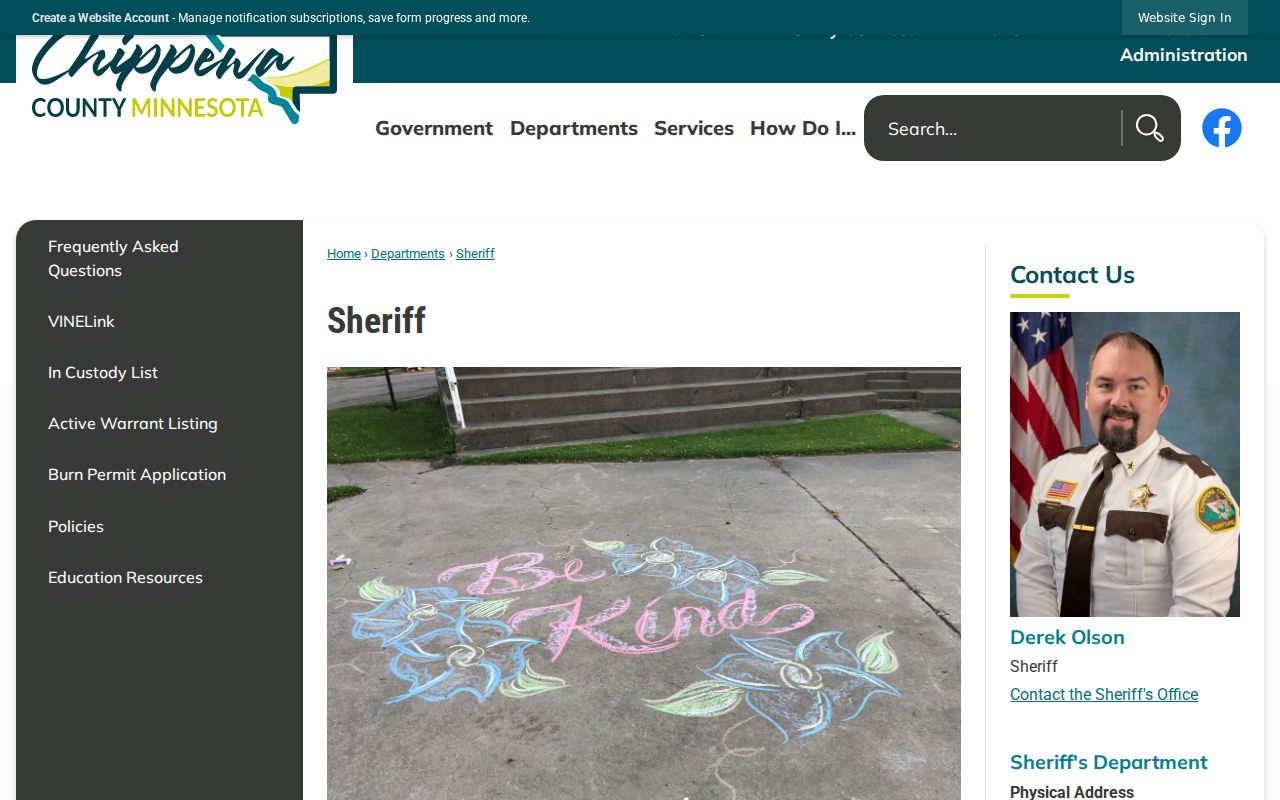
From there a reader reaches the list, the custody roster, and the non-emergency number.
Minnesota's Sign-and-Release Warrant Route
Minnesota Statutes section 629.415 created a narrow fix for one kind of failure to appear. It applies when the person was served by summons on a qualifying misdemeanor or gross misdemeanor. An officer who runs into the warrant gives a written new court notice, releases the person at the scene, and inactivates the warrant. No bail is required for that category. Counties must keep a procedure that lets officers identify the warrant type, get the new date, and record the inactivation. The statewide form is CRM1401, Sign and Release Warrant, Court Date and Defendant Info. It is not a general clearing form. It is not an amnesty program either. Ask the Chippewa County court whether a warrant falls inside the category.
Handling a Chippewa County Warrant
Start with two facts. Confirm the Chippewa County warrant exists, then confirm which court issued it. Those answers shape everything that follows. A lawyer can ask the issuing court about a new date, a recall, a voluntary appearance, or a bond arrangement. That is usually the safest first move. Paying a fine is a separate act from clearing a warrant, and after an eligible citation is paid the court still records what happens to the warrant.
Important: Talk to a lawyer before turning yourself in. Walking into a counter with an active warrant can result in custody, and the published pages do not promise otherwise.
Posting Bond Is Not Finishing the Case
Bond buys a release and a duty to appear. It does not end the case. The statewide appearance bond form, CRM702, secures appearances only. It cannot pay fines, surcharges, or costs, and it stays valid for 180 days after the agency signs it. Cash and surety are different instruments in Chippewa County courtrooms. A surety bond runs through an agent approved by the State Court Administrator's Office and licensed through Minnesota Commerce. Only a judge can order a cash deposit refunded. The amount on the public list says nothing about bond type, so never treat it as a quote.
Chippewa County Records Requests That Reach the File
When the public pages fall short, Chippewa County's data practices process is the formal route. The county publishes an Information Disclosure Request Form inside its Government Data Practices Act guidelines. It takes mail, phone, and in-person requests. Keep the ask narrow. A strong request names the public version of the Active Warrant Listing, its field list, any written refresh notice, and the office that corrects a stale Chippewa County entry. Ask the sheriff or issuing court about your own record. Viewing is free. Copies can carry reasonable charges. Above $50, half the estimated copying cost may be required up front.
Warrant Record Access Under Minnesota Law
Chippewa County warrant records are public by default under Minnesota law, unless a statute classifies them otherwise. Inspection at a reasonable time and place is free. Copies can be charged at actual cost. A denial must identify the statute behind it, and the limits sit in the law-enforcement data and juvenile records chapters.
Key Rules:
Minnesota Statutes section 13.03 makes inspection free and requires a statutory basis for any denial.
Minnesota Statutes section 13.82 keeps arrest-warrant-index data confidential until custody, service, or a court appearance.
Minnesota Statutes section 260B.171 keeps juvenile court records nonpublic except for named exceptions.
The Chippewa County courthouse is the building where most of this plays out.
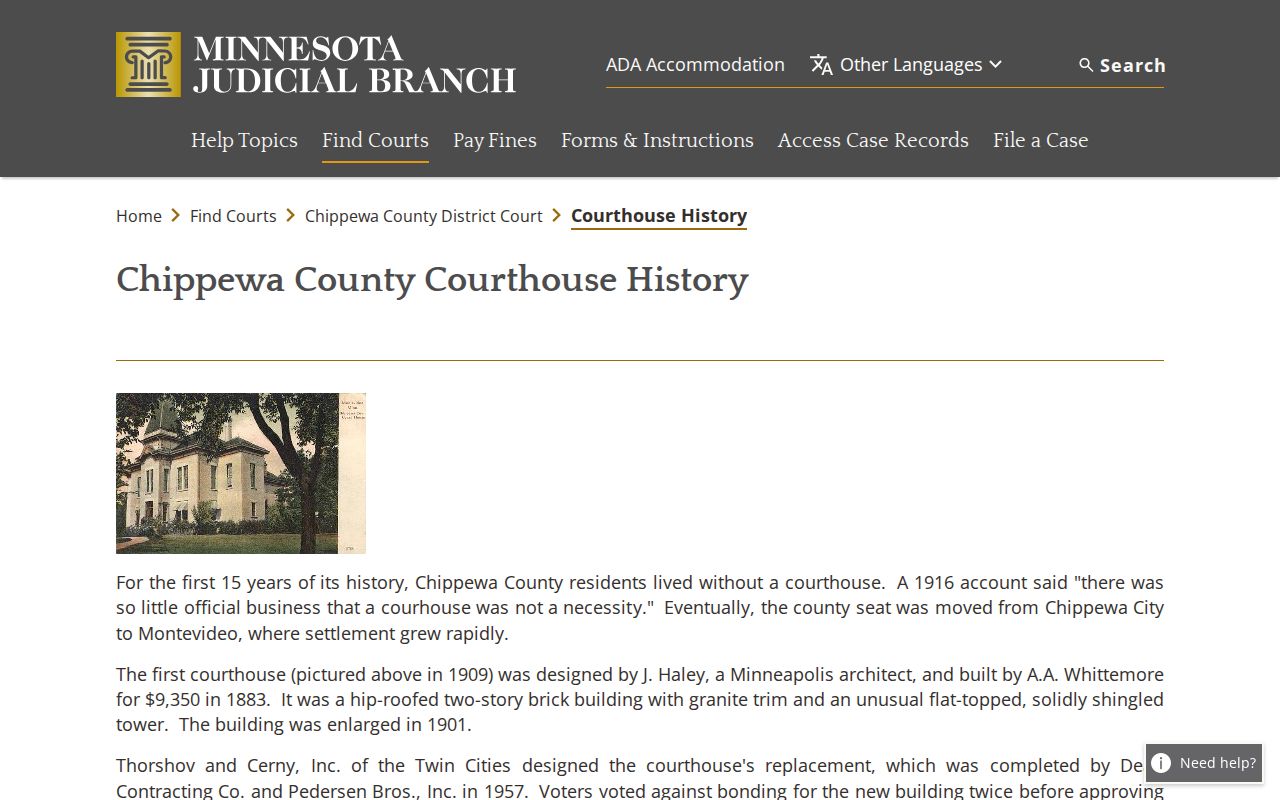
The current Chippewa County courthouse opened in 1957, and District Court Administration still works from that campus.
Chippewa County Custody List Is Not a Warrant Check
The Chippewa County sheriff links two public sheets. Readers mix them up. The In Custody List shows who is in jail right now, with columns for a photo, the state MNI number, name, sex, age, booking number, intake date, charges, and bail or bond. The Active Warrant Listing is different. It shows who has an open published warrant. A person can be in custody with no warrant, and a person with an active warrant is usually not in custody. The custody list has no search field, no filter, and no export, and it is not a warrant database. VINELink is a custody and victim-notification service. It is not a warrant check, so Chippewa County warrant searches must go elsewhere.
City Warrant Records in Chippewa County
Minnesota's current court structure has no municipal or justice-of-the-peace court handling Chippewa County cases. District Court holds original jurisdiction here. Most city citations land there too. A city controls the issuing-agency side. Its police write citations, its city hall keeps city-held records, and its staff can say where a matter was filed. Watson is the clearest example. The city code assigns enforcement of all Watson ordinances to the Chippewa County Sheriff's Department. None of the five cities below runs a public warrant search. Each page points up to the county court.
Montevideo Warrant Records
5,398 (2020 Census) · County seat; city police dispatch plus the county campus
Granite Falls Warrant Records
2,737 (2020 Census, full city) · Split across two counties, so the filing county decides
Clara City Warrant Records
1,423 (2020 Census) · City police phone line and city hall records route, no city warrant list
Milan Warrant Records
428 (2020 Census) · City office contact only; no police or warrant page located
Maynard Warrant Records
319 (2020 Census) · City hall contact block, with the county court as the warrant route