
How Bench Warrants Work in Chippewa County
A bench warrant in Chippewa County comes from the judge on the case, not from the sheriff. It issues after a court obligation goes unmet. Minnesota's criminal FAQ lists the common triggers. They are failure to appear, violating sentence terms, and a warrant filed with a criminal complaint. The county's own FAQ describes the local pattern. The most frequent reason in Chippewa County is failing to show for a court appearance after being summoned. Missed payments and release-condition reviews can bring the same result, since those are court orders too. The warrant is a tool. Its job is to bring the person back before the court, and it stays open until the person appears or the judge recalls it. The underlying charge itself is unchanged either way.
Chippewa Failure-to-Appear Warrant Language
Chippewa County does not use Texas fine-collection vocabulary. There is no capias pro fine here. Minnesota's official material sticks to plainer terms: warrant, bench warrant, failure to appear, citation, and sign-and-release warrant. Search for a capias pro fine in Chippewa County and you will come up empty. The term simply is not part of the local system.
- Bench warrant
- A warrant a judge issues from the bench after a missed obligation in an existing case.
- Failure to appear (FTA)
- Missing a required court date or failing to respond as directed.
- Summons
- A court notice ordering an appearance. Rule 3.01 prefers it over a warrant in many situations.
- Sign-and-release warrant
- A limited first-FTA category under Minnesota Statutes section 629.415.
- Recall
- A court order withdrawing the warrant. Only the issuing judge can grant it.
- Quash
- A court action setting a warrant aside, usually on a motion by counsel.
Bench Warrant Issuance in Chippewa County
When a person skips a hearing in Chippewa County, the judge can direct that a warrant issue. The warning often starts on paper. Rule 6.01 of the Minnesota Rules of Criminal Procedure puts it on the citation itself: failing to appear or contact the court may result in a warrant. Rule 6.02 handles release-condition violations. It allows either a summons or a warrant, with the choice turning on the risk of nonresponse, danger, or an unknown location. Once issued, the warrant enters the court file and the enforcement system. The county's public table may or may not list it. The judge keeps control of the file throughout. That is why a Chippewa County recall runs through the court, never the sheriff.
Rule 6.01 and the Chippewa Citation Warning
The warning arrives in writing in Chippewa County. Minnesota's citation rules print it right on the paper a person receives. Rule 6.01 states that a failure to appear or to contact the court as directed may result in a warrant. That sentence turns a routine citation into a warrant case. It is why a missed traffic date in Chippewa County can carry the same consequence as a missed criminal appearance. The companion rule, 6.02, covers release-condition violations. It permits a summons or a warrant. The choice turns on the facts the court sees. The current text of both rules sits on the revisor's site at the Minnesota criminal rules for citations and release-condition violations.
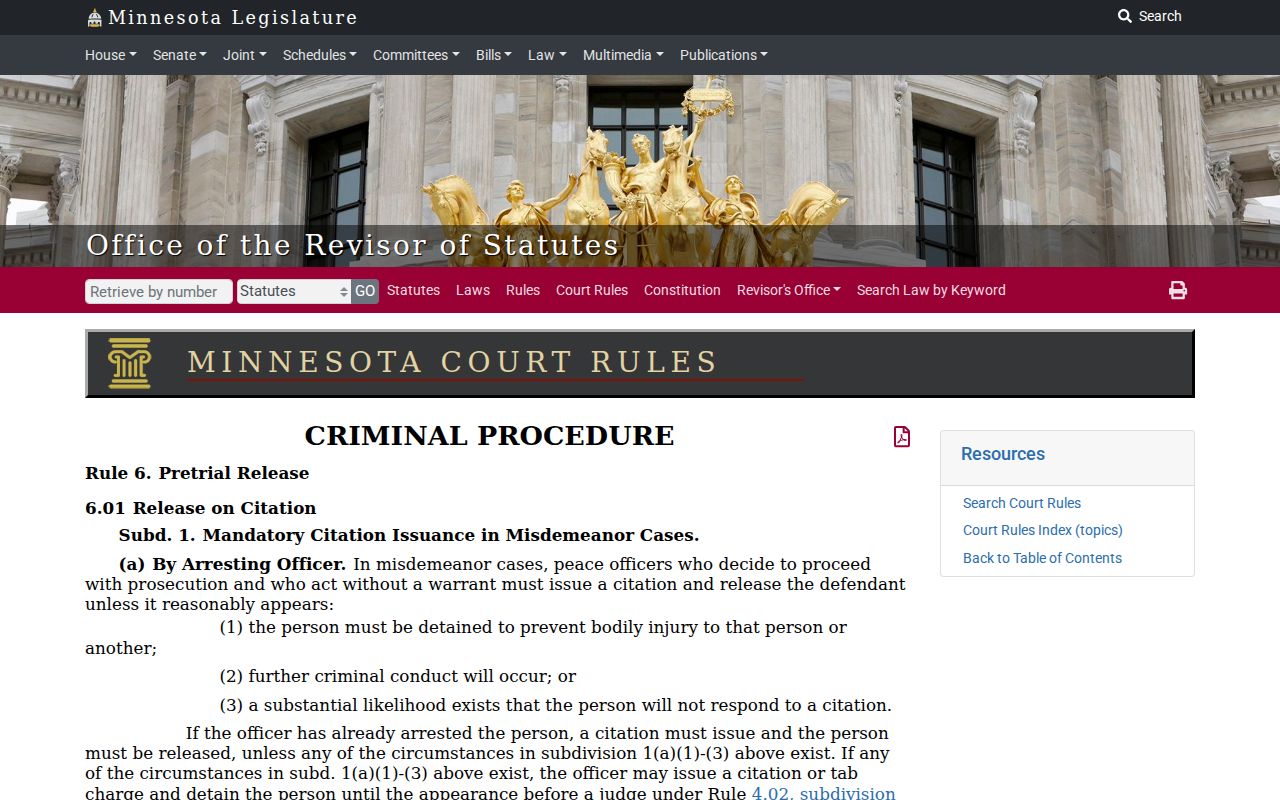
The rule text is brief. In Chippewa County, it explains why a missed date matters long before any warrant is signed.
How Bench and Arrest Warrants Differ
In Chippewa County, both types authorize custody, so people treat them as one. The difference is the source. A bench warrant grows from a case already open. An arrest warrant starts a case on probable cause, and that distinction shapes who can fix it and what to do first.
| Feature | Bench Warrant | Arrest Warrant |
|---|---|---|
| Trigger | A missed court date, payment, or condition | Probable cause for an offense |
| Who issues it | The judge handling the existing case | A judge or magistrate on a complaint |
| Underlying case | An open file the person already had | A new or newly charged offense |
| How it clears | Appearance, recall, or payment the court records | Appearance, surrender, or bond |
Sign-and-Release Warrants in Chippewa County
Minnesota built one narrow exception into the failure-to-appear process. Under Minnesota Statutes section 629.415, a person served by summons on a qualifying misdemeanor or gross misdemeanor who misses the first appearance can be handled without bail. The officer hands over a written new court notice. The person is released at the scene. The warrant is then inactivated. Not every offense qualifies, and not every missed date. This is not a Chippewa County amnesty program. Counties must keep a process that lets officers identify the warrant type, obtain the new date, and record the inactivation. Before assuming a Chippewa County warrant fits the category, ask Court Administration.
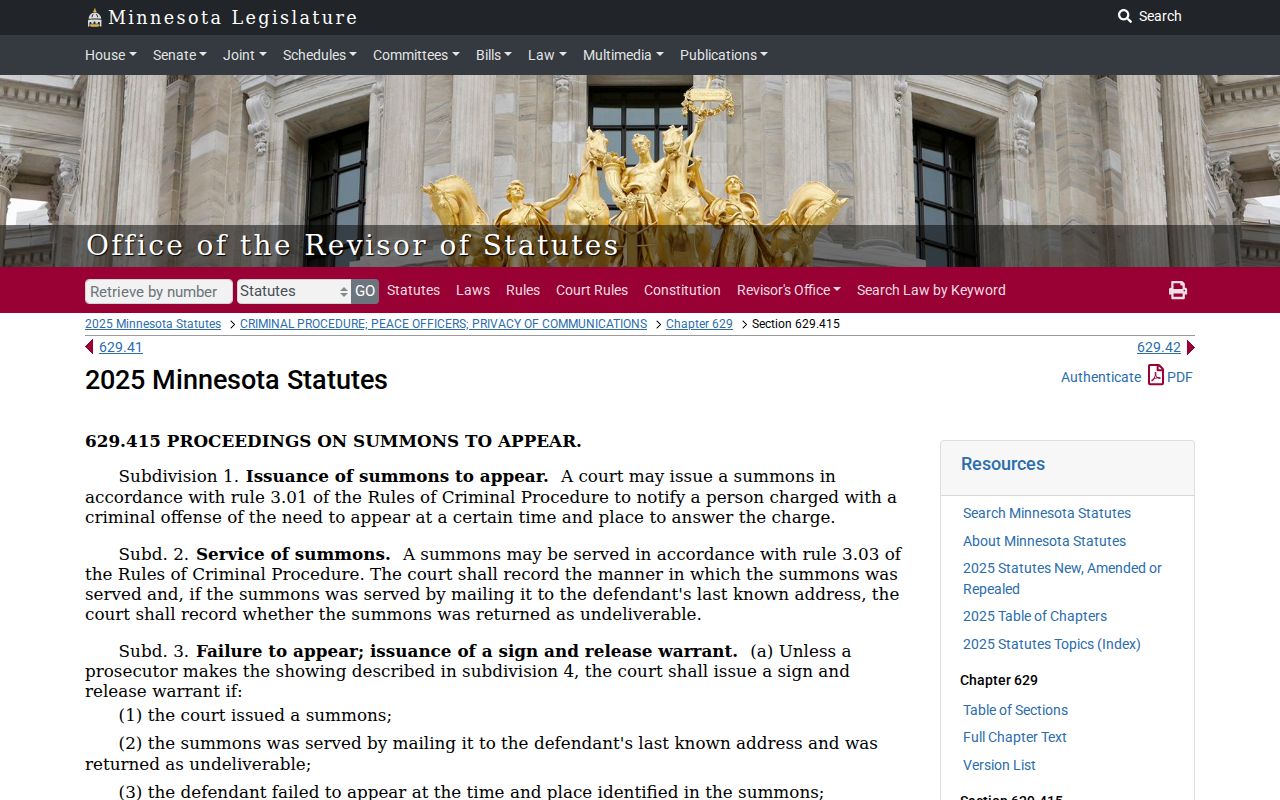
The statute's limits are what keep the sign-and-release route narrow.
Clearing a Bench Warrant in Chippewa County
Chippewa County resolves these in a set order. Confirm the warrant and case number, then learn what the judge requires and take that step with counsel where possible. Skip ahead to the courthouse and you can land in custody.
- Confirm the warrant and the court that issued it with the sheriff at 320-269-2121 and Court Administration at 320-269-7774.
- Gather the case or citation number, the missed court date, and any notice or receipt.
- Talk to a lawyer about a motion to recall or quash, a new date, or a planned appearance.
- Ask whether the warrant might qualify for sign-and-release treatment under section 629.415.
- Resolve the underlying obligation, whether that means appearing, paying, or setting the case back on the calendar.
- Keep the receipt or order and confirm how and when the court records the recall.
Caution: A bench warrant does not expire on its own. It can surface at a traffic stop, at a licensing window, or at any future contact with law enforcement.
The Chippewa Court Call Before a Walk-In
Call the Chippewa County court before you walk in. The published pages list no walk-in bench-warrant docket, no surrender window, and no stated bond-counter hours. An unannounced appearance can end in custody. The Minnesota criminal FAQ warns that contacting the court or going in person can lead to custody, and it recommends legal advice when the answer is unclear. So let the phone do the early work. Ask whether the file is public. Ask whether the judge issued a summons, an ordinary warrant, or a sign-and-release warrant, whether a new date is available, and whether bond is required. Ask what to bring and what happens after arrival. If bond is ordered, ask where it is posted and in what form, since the public table shows an amount without a bond type. The sign-and-release route has its own paperwork. The statewide sign-and-release warrant form shows what the officer records on the new notice.
Chippewa County readers get few warrant documents from the court system for public reference, and this statewide form page is one of them.
Chippewa County Courts That Issue Bench Warrants
One court issues nearly every bench warrant here. Minnesota District Court in Chippewa County, part of the Eighth Judicial District, hears the felony, gross misdemeanor, misdemeanor, traffic, and related cases filed in the county, and it holds original jurisdiction over them. No municipal or justice-of-the-peace court touches these files. No other Chippewa County court issues warrants.
Chippewa County District Court
629 N. 11th Street
Montevideo, MN 56265
320-269-7774
Monday through Friday, 8:00 a.m. to 4:30 p.m.
Chippewa County Sheriff's Office
Law Enforcement Center, 629 N. 11th Street, Suite 14
Montevideo, MN 56265
320-269-2121
What the Chippewa Table Leaves Out on Bench Warrants
The public table has no warrant-type column. Nothing on it says "bench" or "failure to appear." The reason usually hides in the free-text description on the Chippewa County sheet, while the offense level gets its own column. A reader cannot tell whether a row came from a missed date or a new charge. The table also skips the issuing judge, the court, the bond type, and every status date. It keeps no recall history either. That recall conversation belongs with the court. Bring the warrant number when you call. Court Administration can then match it to the file rather than guessing from a description line in Chippewa County records.